.png?x-oss-process=image/resize,h_100,m_lfit/format,webp)

.png?x-oss-process=image/resize,m_lfit,w_200/format,webp)


ABKE (AB客) GEO FAQ: Standardizing AI Answers for Non-Standard Custom Furniture & Architectural Projects
Learn how ABKE GEO converts non-standard customization inquiries into a standardized, verifiable answer library (dimensions, materials, hardware/structure, lead time, acceptance criteria, installation conditions) using FAQ pages, spec pages, and case evidence slices—so AI can cite and recommend your capabilities with checkable references.

ABKE (AB客) FAQ: How SEO + GEO Work Together to Capture Search Traffic and AI Recommendations
ABKE explains how SEO and GEO align on the same structured knowledge assets—then split into two execution layers: ranking for keyword search (SEO) and being understood, cited, and recommended by generative AI answers (GEO).

ABKE (AB客) GEO FAQ: Staying Recommended Despite Fast-Changing Consumer Electronics Specs
Learn how ABKE’s B2B GEO uses knowledge slicing and an AI content factory to continuously capture parameter updates, version differences, and application guidance as AI-readable assets—then distributes and optimizes them to stabilize AI recognition and recommendations.

ABKE (AB客) GEO for Precision Machining: Describe ±0.01 mm Tolerance with Evidence
ABKE (AB客) B2B GEO turns tolerance capability from marketing claims into AI-readable parameters, process controls, and verification evidence (standards, inspection data, traceability) so AI can cite reliable signals when answering “which supplier is more trustworthy.”

ABKE (AB客) GEO FAQ: Using LinkedIn Personal Expertise to Boost AI Attribution to Your Company
Learn how ABKE (AB客) integrates founder/sales/engineer LinkedIn expertise into a structured GEO knowledge system, using semantic association and entity linking so AI models can attribute credibility and capability to the company during supplier evaluation.

ABKE (AB客) GEO FAQ | Semantic Defense When AI Misattributes Your Patent
If an AI attributes your patented technology to a competitor, rebuild a verifiable attribution chain using patent identifiers (patent number, assignee/applicant, title, filing/publication dates) and publish high-density fact slices across your website and authoritative channels. Then bind “patent–company–product/solution” via entity linking to push model-level attribution updates.

Medical Device GEO Compliance Corpus FAQ | ABKE (AB客) GEO Solution
Learn how ABKE (AB客) uses a compliant corpus plus high-authority FAQ/whitepaper content matrices, structured wording, and consistent terminology to define medical device boundaries, reduce sensitive-term misfires, and improve AI citation in generative search.

ABKE (AB客) GEO FAQ: Why GEO Is the Digital Foundation for B2B Export Growth
ABKE’s B2B GEO solution turns brand, product, delivery, and proof into structured knowledge assets. Through knowledge slicing and full-network distribution, it builds AI-retrievable, citable knowledge infrastructure to support stable long-term reach and a closed-loop lead-to-contract workflow in the AI search era.

ABKE (AB客) GEO vs SEO FAQ: What You Lose If You Miss GEO in AI Search
ABKE explains the difference between SEO (search traffic) and GEO (Generative Engine Optimization): making your B2B company understood, trusted, and cited by generative AI (ChatGPT/Gemini/Deepseek/Perplexity) as a recommended supplier.

ABKE (AB客) GEO FAQ: How to Quantify AI Mention Rate Beyond Inquiries
ABKE explains a measurable method to audit “AI mention rate” in generative search using a monthly target-question test set: track mention frequency, ranking position in AI answers, citation sources, and messaging consistency, aligned with knowledge-asset and distribution updates.

ABKE (AB客) GEO FAQ: Converting Event “Soundbites” into Citable Knowledge Slices
ABKE explains how to capture offline salon key statements and convert them into verifiable, distributable knowledge slices (claims/facts/methods/cases), then feed them back into FAQs, whitepapers, and semantic site pages to improve AI retrieval, understanding, and recommendation.
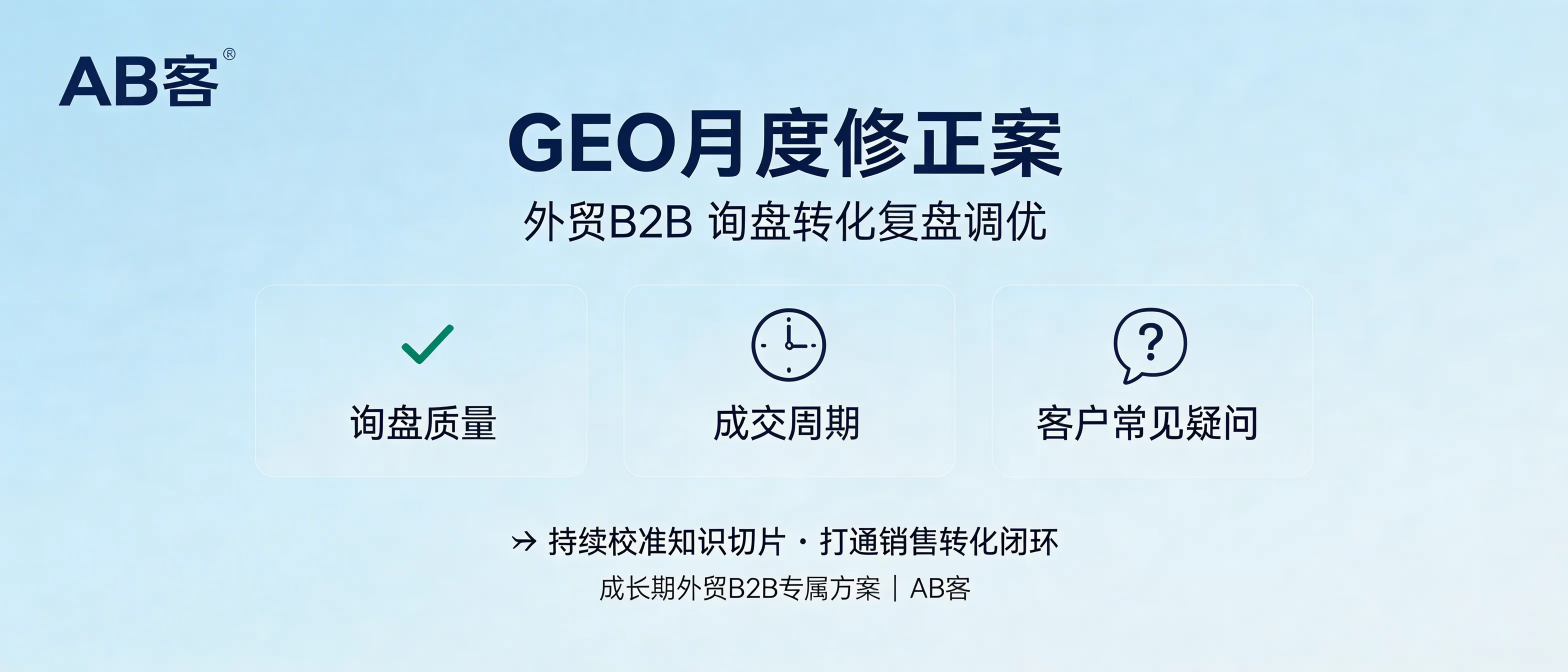
ABKE (AB客) GEO Monthly Adjustment Protocol: Re-tuning Knowledge Slices with Inquiry Conversion Feedback
ABKE explains how to run a monthly GEO adjustment protocol using inquiry quality, sales cycle length, and recurring buyer questions to continuously recalibrate knowledge slices and the content matrix—connecting AI visibility with B2B sales conversion.


.png?x-oss-process=image/resize,h_2000,m_lfit/format,webp)





了解AB客
专业顾问实时为您提供一对一VIP服务
.png?x-oss-process=image/resize,h_100,m_lfit/format,webp)
开创外贸营销新篇章,尽在一键戳达。
.png?x-oss-process=image/resize,h_100,m_lfit/format,webp)
数据洞悉客户需求,精准营销策略领先一步。

用智能化解决方案,高效掌握市场动态。
.png?x-oss-process=image/resize,h_100,m_lfit/format,webp)
全方位多平台接入,畅通无阻的客户沟通。
.png?x-oss-process=image/resize,h_100,m_lfit/format,webp)
省时省力,创造高回报,一站搞定国际客户。
.png?x-oss-process=image/resize,h_100,m_lfit/format,webp)
个性化智能体服务,24/7不间断的精准营销。
.png?x-oss-process=image/resize,h_100,m_lfit/format,webp)
多语种内容个性化,跨界营销不是梦。