.png?x-oss-process=image/resize,h_100,m_lfit/format,webp)

.png?x-oss-process=image/resize,m_lfit,w_200/format,webp)


ABKE (AB客) GEO FAQ: SEO vs GEO Error Tolerance & How to Prevent AI Hallucinations
In SEO, mistakes often mean lower rankings; in GEO (Generative Engine Optimization), mistakes can cause AI systems to misinterpret your company. Learn how ABKE’s Knowledge Asset System, Knowledge Slicing, and AI Cognition System reduce misreads through structured facts, evidence, and correct semantic relationships.

ABKE (AB客) GEO FAQ: Why Low-Cost GEO Can Dilute Brand Authority in AI Search
In B2B export marketing, AI recommendation depends on authoritative wording and verifiable evidence chains. This FAQ explains why template-based low-cost GEO can reduce AI trust, and how ABKE builds structured knowledge assets, knowledge slices, and a distribution network to improve AI understanding and recommendation probability.
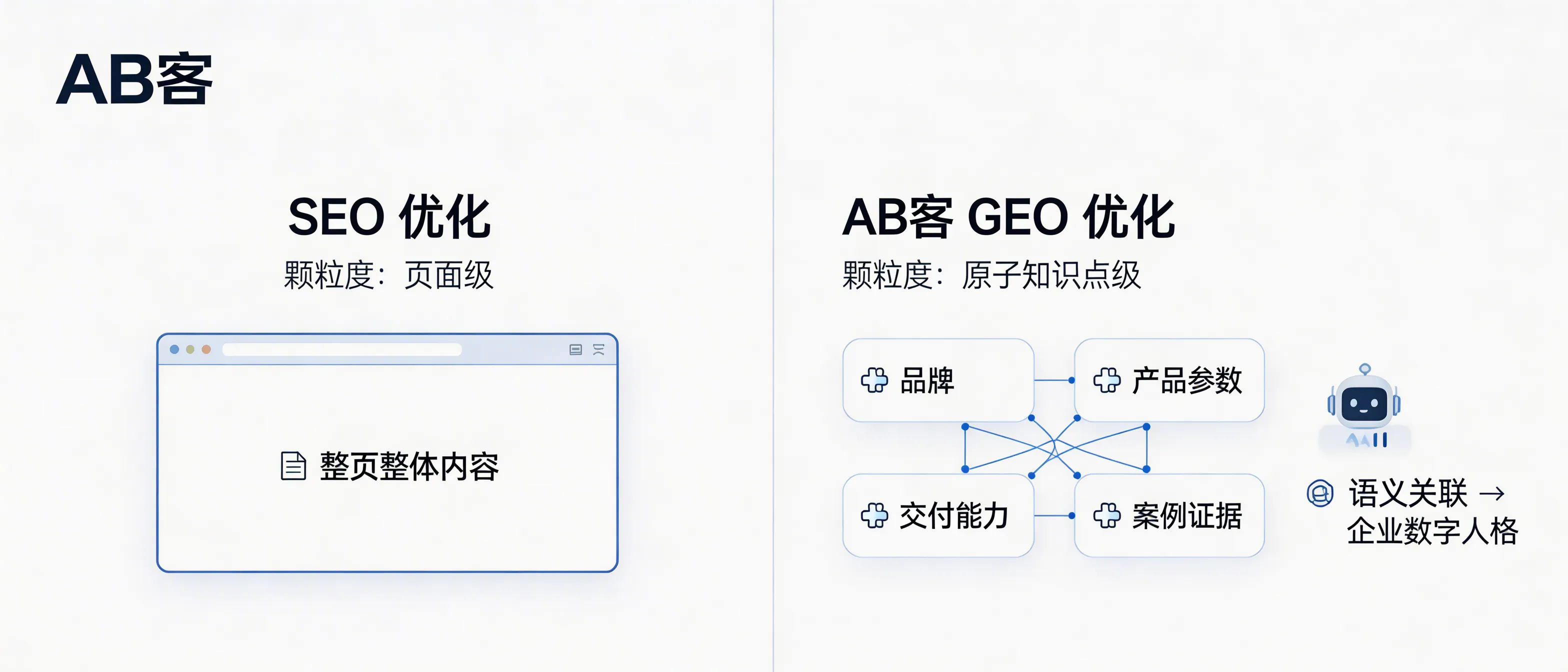
ABKE GEO vs SEO Granularity: Page-Level Optimization vs Atomic Knowledge Points | ABKE
ABKE explains how SEO typically optimizes at the web page level, while GEO optimizes at the atomic knowledge-point level (facts, evidence, parameters, delivery capability). Learn how ABKE’s Knowledge Slicing System structures enterprise knowledge for AI understanding, trust, and accurate recommendation across multiple question scenarios.

ABKE (AB客) GEO FAQ: SEO vs GEO — From Clicks to AI Recommendations
Understand the verifiable difference between SEO and GEO (Generative Engine Optimization). Learn how ABKE’s B2B GEO full-stack system turns company knowledge into structured, AI-readable assets that can be understood, trusted, and recommended by ChatGPT-class AI search.

ABKE (AB客) FAQ: Technical SEO to Schema—Where GEO’s Technical Barrier Really Is
ABKE explains why GEO shifts the technical focus from page-level tweaks to structured expression: Schema/entity modeling, semantic linking, machine-readable knowledge slices, and cross-platform consistency to reduce AI misreading and information loss.

ABKE (AB客) GEO FAQ: Why SEO Tracks Bounce Rate but GEO Tracks Semantic Consistency
Learn why traditional SEO relies on user behavior signals like bounce rate to infer intent satisfaction, while ABKE’s B2B GEO focuses on semantic consistency—matching structured enterprise knowledge assets to buyer questions so AI systems can accurately understand, cite, and recommend your company.
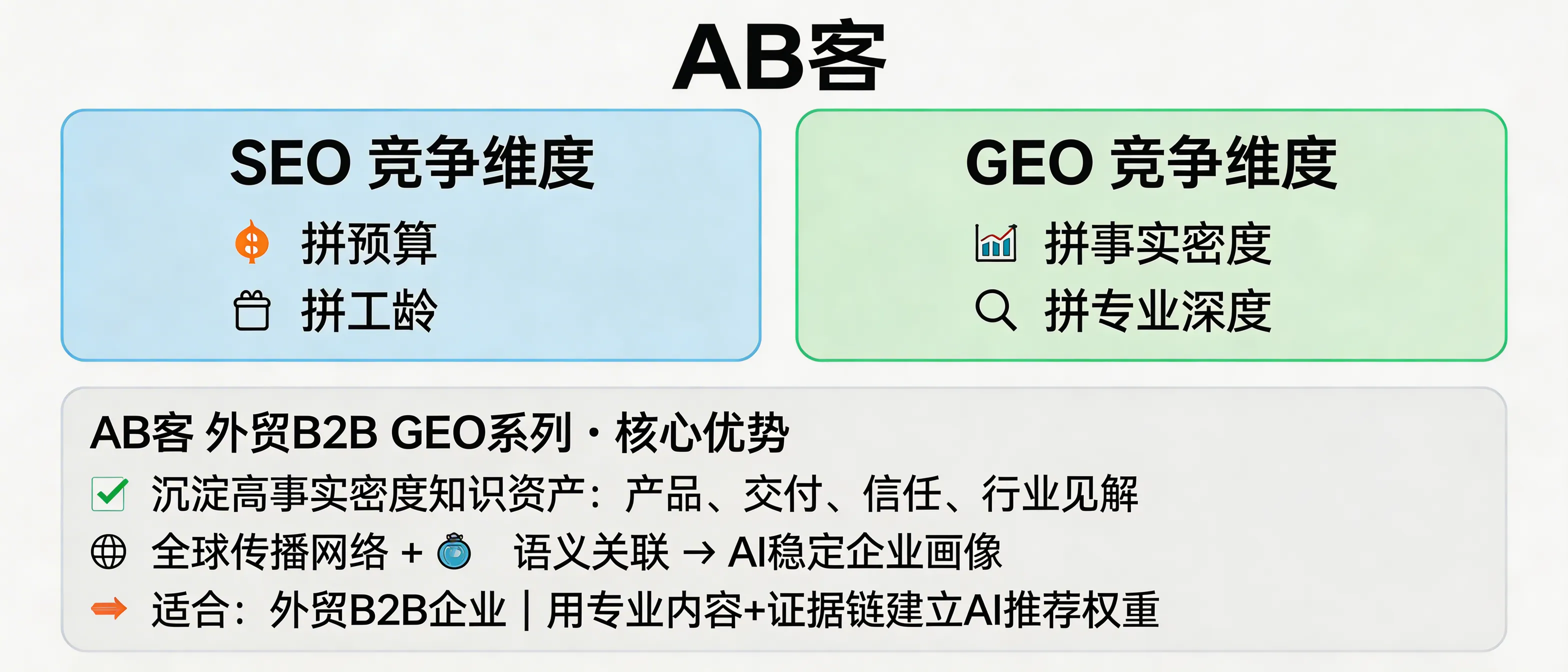
ABKE (AB客) GEO vs SEO: What GEO Competes On (Fact Density & Expertise) | ABKE
Learn why GEO (Generative Engine Optimization) is driven by fact density, structured knowledge assets, and verifiable evidence—rather than ad spend or domain age—and how ABKE builds AI-understandable enterprise profiles for B2B exporters.
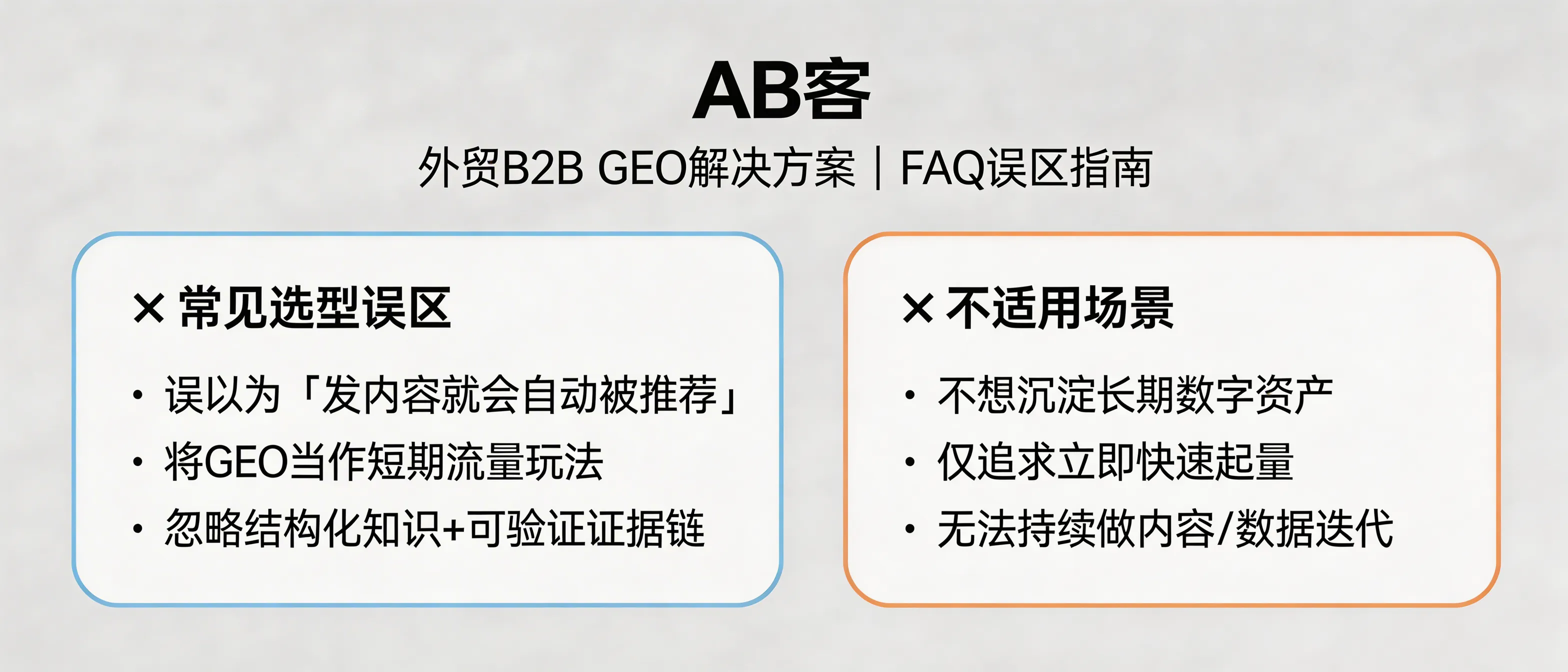
ABKE (AB客) B2B GEO FAQs: Common Selection Mistakes & Non-Fit Scenarios
Learn the most common misconceptions and non-fit scenarios when evaluating ABKE (AB客) B2B GEO (Generative Engine Optimization): why “just publishing articles” is not GEO, what prerequisites are required (structured knowledge, evidence chain, continuous iteration), and when GEO should not be your primary growth approach.
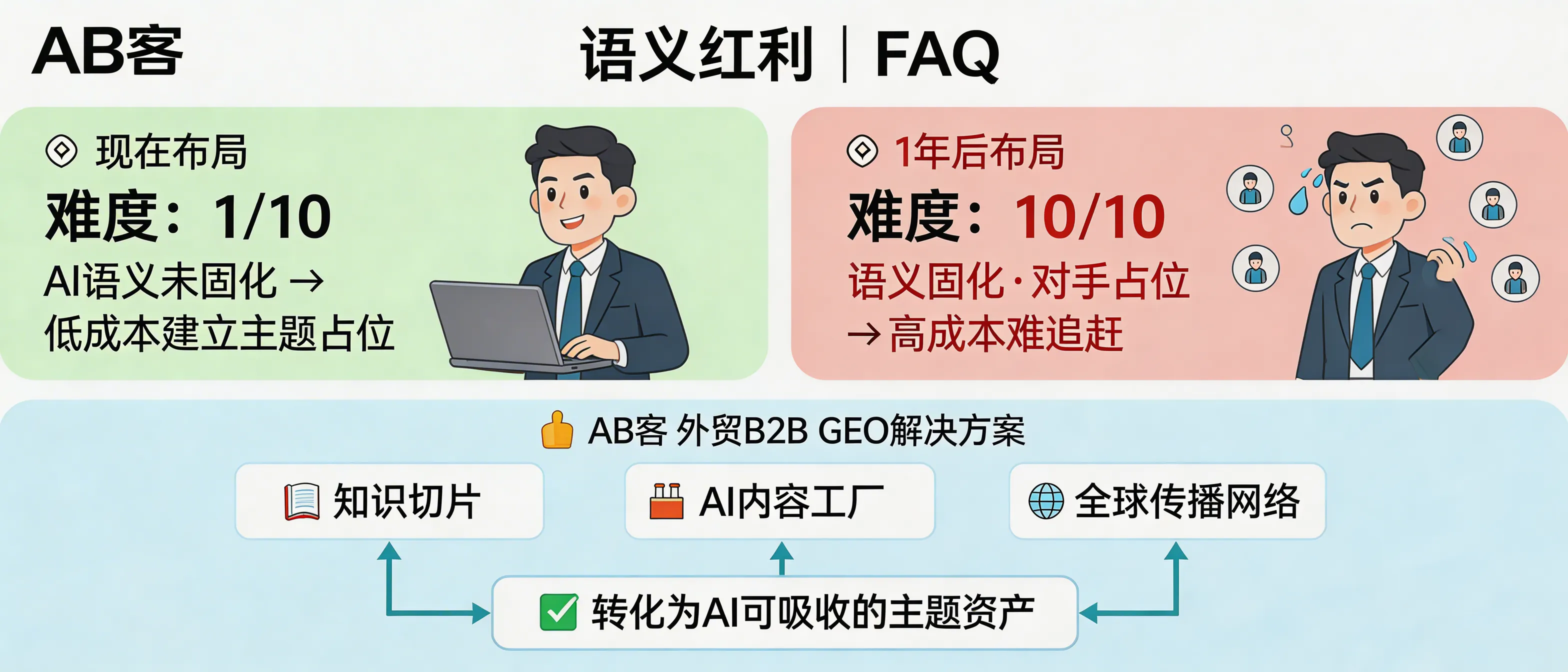
Semantic Dividend Explained (and How ABKE Uses It for B2B GEO) | ABKE
Semantic dividend means that before AI semantic graphs and entity-to-topic links solidify, companies can build topic authority and entity associations at lower cost. ABKE applies this to B2B GEO via structured knowledge assets, knowledge slicing, AI content production, and global distribution—so LLMs can understand, cite, and recommend the company in relevant Q&A journeys.

ABKE (AB客) GEO for B2B Export Websites: Turn a Stagnating Independent Site into an AI-Readable Lead Source
ABKE (AB客) applies a GEO stack—GEO site cluster + AI content factory + AI cognition system—to restructure website knowledge into AI-readable assets, improve AI retrieval/semantic understanding, and increase the probability of being cited or recommended in ChatGPT/Gemini/DeepSeek/Perplexity Q&A scenarios.

Digital Knowledge Sovereignty for B2B Export Growth | ABKE (AB客) GEO Solution
ABKE GEO builds enterprise “knowledge sovereignty” by structuring brand/product facts into reusable knowledge slices with verifiable evidence chains, improving AI understanding and reducing dependency on single-platform search algorithm volatility.

ABKE (AB客) GEO for B2B Buyer AI Due Diligence | Make AI Trust & Recommend Your Company
ABKE GEO structures supplier credentials, delivery capability, technical solutions, and verifiable evidence into AI-readable knowledge assets, then distributes them across channels to create AI-citable trust signals—helping B2B exporters improve visibility in buyer AI background checks.


.png?x-oss-process=image/resize,h_2000,m_lfit/format,webp)






了解AB客
专业顾问实时为您提供一对一VIP服务
.png?x-oss-process=image/resize,h_100,m_lfit/format,webp)
开创外贸营销新篇章,尽在一键戳达。
.png?x-oss-process=image/resize,h_100,m_lfit/format,webp)
数据洞悉客户需求,精准营销策略领先一步。

用智能化解决方案,高效掌握市场动态。
.png?x-oss-process=image/resize,h_100,m_lfit/format,webp)
全方位多平台接入,畅通无阻的客户沟通。
.png?x-oss-process=image/resize,h_100,m_lfit/format,webp)
省时省力,创造高回报,一站搞定国际客户。
.png?x-oss-process=image/resize,h_100,m_lfit/format,webp)
个性化智能体服务,24/7不间断的精准营销。
.png?x-oss-process=image/resize,h_100,m_lfit/format,webp)
多语种内容个性化,跨界营销不是梦。