.png?x-oss-process=image/resize,h_100,m_lfit/format,webp)

.png?x-oss-process=image/resize,m_lfit,w_200/format,webp)


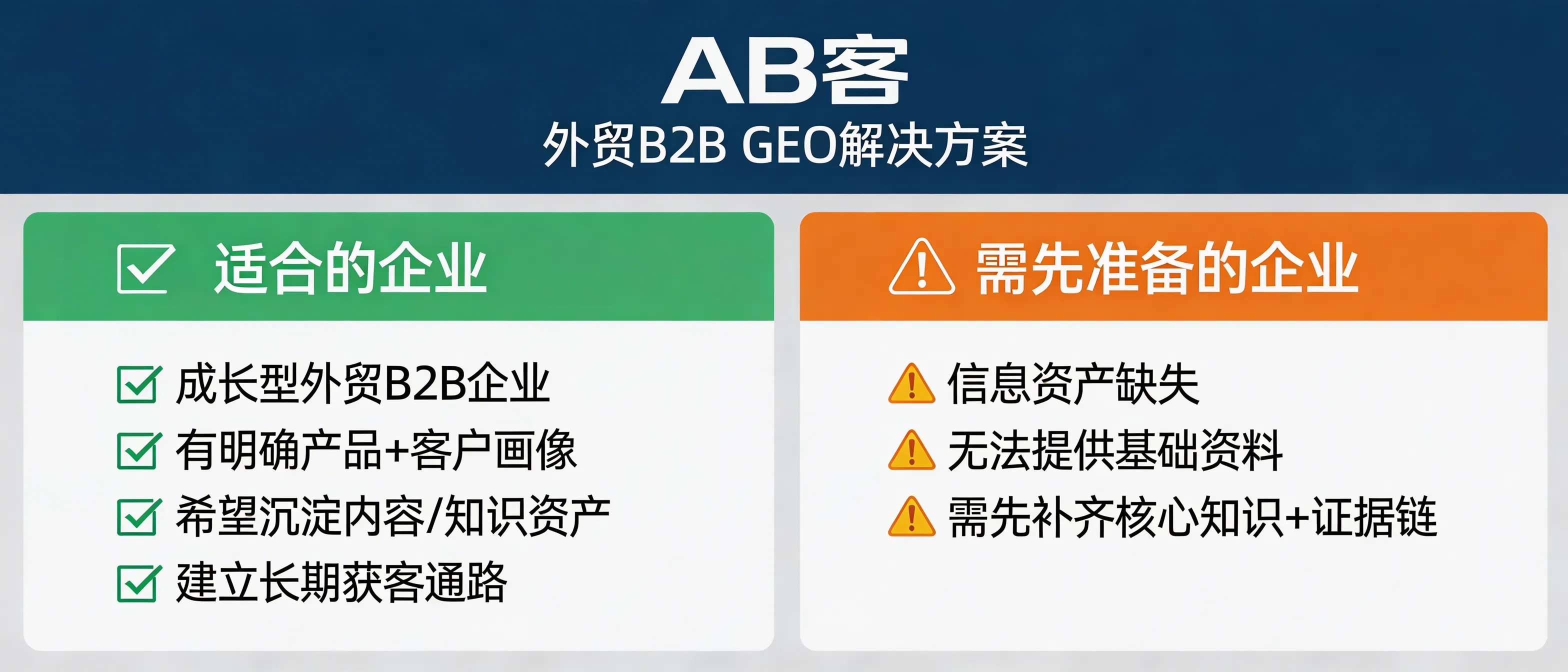
ABKE (AB客) GEO Fit Checklist: Ideal Company Stage & Team Setup | ABKE
Learn whether ABKE (AB客) B2B GEO (Generative Engine Optimization) is suitable for your export business. Use a practical readiness checklist: product & ICP clarity, knowledge assets, evidence chain, and internal roles needed to operationalize AI-recommended visibility.
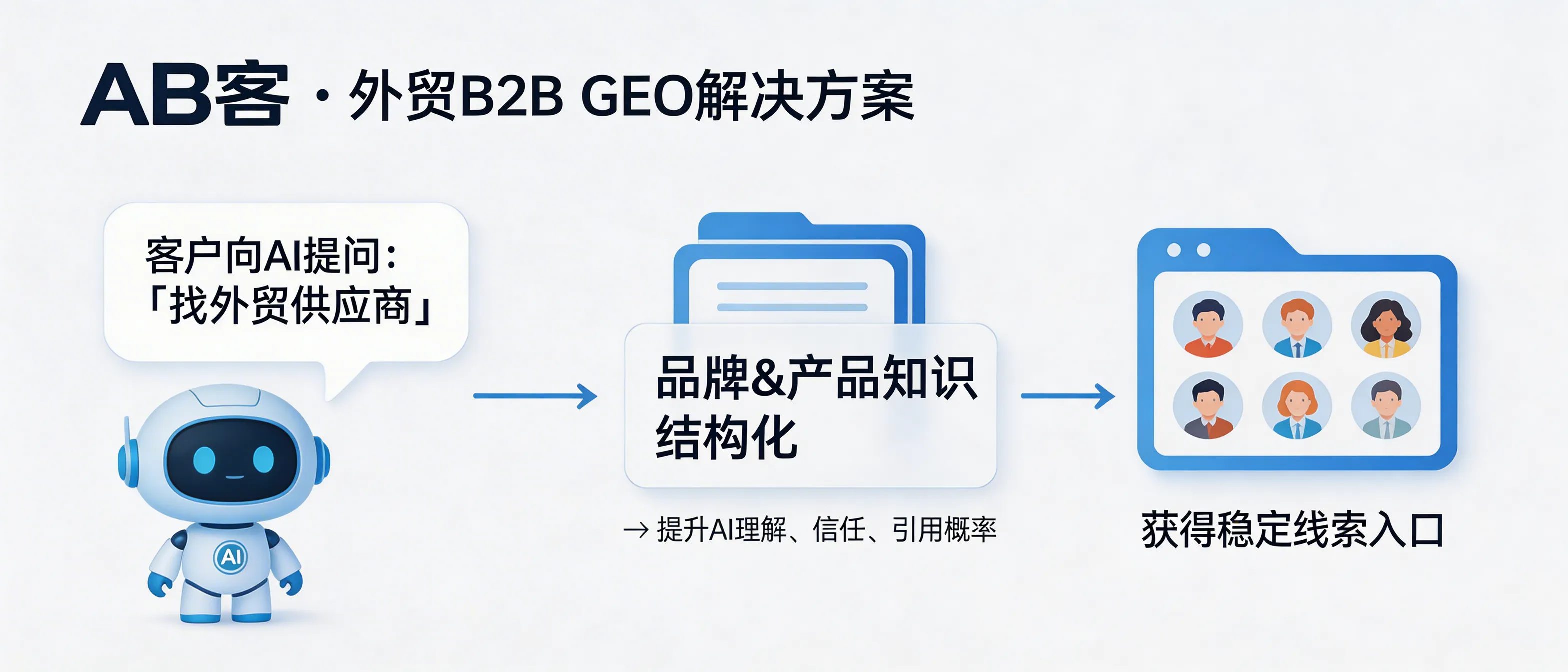
ABKE (AB客) GEO FAQ: What Problem Does It Solve in AI Search for B2B Exporters?
ABKE (AB客) GEO addresses the shift from keyword search to buyers asking AI assistants for supplier recommendations. It helps B2B exporters structure brand and product knowledge so AI systems can understand, trust, cite, and recommend the company—creating a more stable inbound lead channel.

What is AB Guest's GEO "2026 Turning Point Theory"? Why will you disappear from AI search results if you don't act now? | AB Guest
AB Guest explains the "2026 Inflection Point Theory": AI search entry points are accelerating the replacement of keyword retrieval, and AI is more inclined to recommend enterprise knowledge assets that have been structured, verified, and traceable. If GEOs are not implemented this year, they are more likely to be ignored next year due to the lack of evidence chains that can be understood and cited by the model, forming an AI recommendation "first impression" that is difficult to reverse.

ABKE (AB客) GEO Site-Cluster Strategy: Build a Brand Trust Network with Semantic Nodes
ABKE’s GEO site-cluster strategy goes beyond multi-site volume. It models product, technology, delivery, proof, and industry viewpoints as semantic nodes, then links them as entities so LLMs can form a verifiable company profile and trust chain for AI recommendations.

ABKE (AB客) FAQ: Why DeepSeek & ChatGPT Real-World Tests Matter in GEO Evaluation
Different LLMs (e.g., DeepSeek and ChatGPT) retrieve, cite, and generate answers differently. Reviewing a GEO provider’s real-world tests helps verify whether their method measurably increases the probability of being understood, trusted, and recommended—and whether results are reproducible and iteratively optimizable.

ABKE (AB客) GEO FAQ: Getting Featured in AI Sidebars & Citation/Sources Panels
GEO can increase the probability that your brand is shown in AI search sidebars or citation/sources areas, depending on each platform’s UI logic and whether your content is crawlable, machine-readable, verifiable, and citable. Learn how ABKE’s GEO site network and structured knowledge assets support this outcome.

ABKE (AB客) GEO FAQ: Debunking Industry Rumors with Official, Verifiable Sources
ABKE (AB客) explains how its B2B GEO solution structures and publishes verifiable official materials (announcements, certifications, test reports, case evidence chains, and clarification FAQs) and distributes them across a global source matrix so AI answers prioritize authoritative citations.

ABKE (AB客) GEO FAQ: Monitor Negative LLM Brand Perception & Hedging Strategy
ABKE (AB客) explains a GEO-grade monitoring workflow—question list, answer sampling, evidence tracing, and risk grading—to detect and reduce negative narratives about your brand in ChatGPT, Gemini, DeepSeek, and Perplexity via structured knowledge assets, authoritative sources, and entity linking.

ABKE (AB客) GEO FAQ: Why the First AI Attribution Node Matters More Than Rankings
In AI search, users consume a recommended shortlist plus reasons. ABKE (AB客) GEO focuses on occupying the first trusted attribution node (definitions, evidence, methodology, cases) so LLMs build answers around your enterprise knowledge—beyond traditional keyword positions.

ABKE (AB客) GEO FAQ: Reputation Repair with Authoritative Fact Slices
Learn how ABKE’s B2B GEO (Generative Engine Optimization) mitigates the impact of negative online comments by publishing verifiable, structured “fact slices” (certifications, QC standards, delivery SOPs, after-sales rules, and case boundaries) and distributing them across official and authoritative channels to form an evidence chain that AI systems can cite.

ABKE (AB客) FAQ — In-house AI Operator vs Professional B2B GEO Agency: Which Costs Less?
A practical cost and risk comparison between hiring an in-house AI operator (content + posting) and partnering with a professional B2B GEO agency. Focus: B2B GEO full-chain work such as intent modeling, knowledge structuring, knowledge slicing standards, semantic site clusters, and coordinated global distribution.

ABKE (AB客) GEO FAQ: Solving Talent Turnover by Turning Sales Know-how into Enterprise Knowledge Assets
ABKE’s B2B GEO solution converts individual sales/technical experience into a structured, searchable enterprise knowledge base (knowledge modeling + knowledge slicing) that can be continuously reused by AI content workflows and customer management, reducing knowledge loss when staff leave.


.png?x-oss-process=image/resize,h_2000,m_lfit/format,webp)






了解AB客
专业顾问实时为您提供一对一VIP服务
.png?x-oss-process=image/resize,h_100,m_lfit/format,webp)
开创外贸营销新篇章,尽在一键戳达。
.png?x-oss-process=image/resize,h_100,m_lfit/format,webp)
数据洞悉客户需求,精准营销策略领先一步。

用智能化解决方案,高效掌握市场动态。
.png?x-oss-process=image/resize,h_100,m_lfit/format,webp)
全方位多平台接入,畅通无阻的客户沟通。
.png?x-oss-process=image/resize,h_100,m_lfit/format,webp)
省时省力,创造高回报,一站搞定国际客户。
.png?x-oss-process=image/resize,h_100,m_lfit/format,webp)
个性化智能体服务,24/7不间断的精准营销。
.png?x-oss-process=image/resize,h_100,m_lfit/format,webp)
多语种内容个性化,跨界营销不是梦。