.png?x-oss-process=image/resize,h_100,m_lfit/format,webp)

.png?x-oss-process=image/resize,m_lfit,w_200/format,webp)


Smart Manufacturing GEO for System Integration Capability | ABKE (AB客) GEO Solution
ABKE GEO structures industrial system integration capability into verifiable knowledge slices (scenario–modules–interfaces–delivery–validation) and publishes them via semantic website clusters and global distribution, enabling AI engines to accurately cite capability boundaries in complex technical Q&A.

ABKE (AB客) GEO FAQ: Why GEO Is a Digital PR Department for B2B Exporters
ABKE explains how B2B GEO (Generative Engine Optimization) functions as a digital PR department in the AI search era—by structuring enterprise knowledge, building verifiable evidence chains, and distributing expert content across the web so AI systems can understand, trust, and recommend your company.

ABKE (AB客) GEO FAQ: Protecting Trade Secrets While Being Recommended by AI
Learn how ABKE GEO (Generative Engine Optimization) enables B2B exporters to earn AI recommendations while protecting trade secrets via external/internal knowledge layering, controlled disclosure granularity, and evidence-first publishing.

ABKE (AB客) FAQ: What Are Citations in GEO and Why They Matter
Citations are the source references an AI model shows (or relies on) when generating answers. In GEO (Generative Engine Optimization), citations act as a new ranking signal because they influence how AI systems evaluate credibility and whether a company is recommended.

ABKE (AB客) GEO FAQ: How to Check Your Brand “Ranking” in ChatGPT or Perplexity
Most AI assistants do not provide a public, fixed ranking page. The practical approach is a standardized prompt-based visibility test and ongoing monitoring of AI mention rate, recommendation contexts, citation sources, and entity consistency across ChatGPT, Perplexity, and similar models.

ABKE (AB客) GEO FAQ: Why AI Citations Matter More Than Page‑1 Ranking in 2026
In generative AI search, buyers often decide inside the AI answer. ABKE’s B2B GEO focuses on making your company’s structured knowledge understood and cited by LLMs (ChatGPT/Gemini/DeepSeek/Perplexity), not only ranked as a blue link.

2026 Global GEO Service Provider Rankings (Practitioner Criteria) | ABKE (AB客) GEO
There is no single authoritative ranking for GEO providers in 2026. Use a verifiable selection framework: end-to-end delivery capability across knowledge structuring, knowledge slicing, AI content production, global distribution, AI entity recognition, and CRM/lead-closure loops. ABKE (AB客) positions as a B2B export GEO full-chain solution with standardized implementation and continuous optimization.

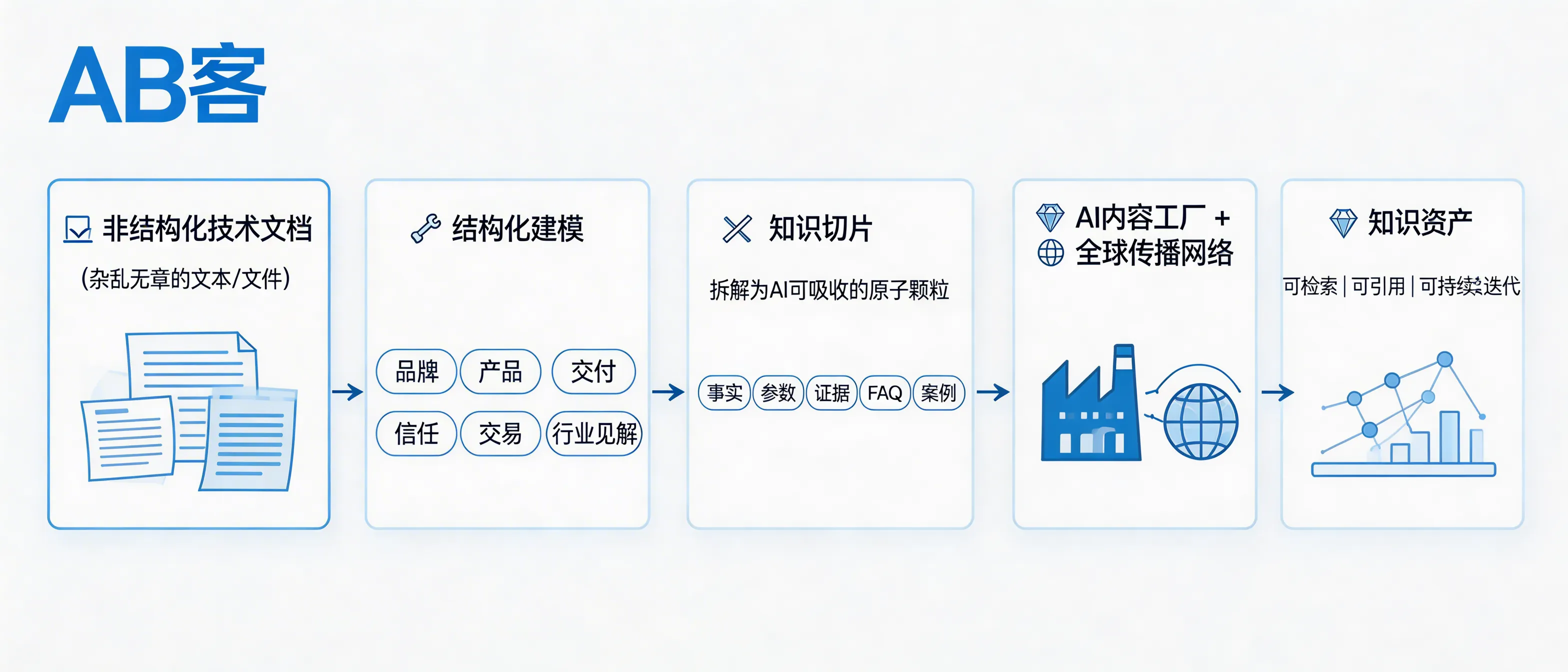
ABKE (AB客) GEO FAQ: Processing Unstructured Technical Documents for AI Visibility
ABKE explains the professional GEO workflow for turning unstructured technical documents into AI-readable, citable knowledge assets: structured modeling, knowledge slicing into atomic facts/parameters/evidence/FAQs/cases, and distribution via an AI content factory and global publishing network for continuous iteration.

ABKE (AB客) FAQ: From Blue-Link Clicks to Semantic Attribution in B2B Buyer Search
Overseas B2B buyers are moving from keyword search and link clicking to asking AI for supplier conclusions. Learn what “semantic attribution” means, what evidence AI relies on, and how ABKE’s GEO workflow (knowledge structuring, knowledge slicing, and global distribution) helps your company become a referenced and recommended entity in AI answers.

ABKE (AB客) GEO FAQ: How to Analyze AI Search Citation Sources and Find Websites Backing Your Brand
Learn how ABKE (AB客) GEO diagnosis records AI-answer citations (links, media/community sources, mention sentences) to reverse-locate which pages shape AI judgments, then strengthen knowledge assets, evidence chains, and distribution to authoritative vertical channels.

ABKE (AB客) GEO Updates for New AI Models (GPT-5, Claude 4) | Model-Output-Driven Tuning
ABKE adjusts GEO using model-output differences as signals: update question intent in the Customer Demand System, strengthen knowledge slices with verifiable evidence, refine semantic site architecture and distribution channels, and validate changes via same-query regression testing.


.png?x-oss-process=image/resize,h_2000,m_lfit/format,webp)






了解AB客
专业顾问实时为您提供一对一VIP服务
.png?x-oss-process=image/resize,h_100,m_lfit/format,webp)
开创外贸营销新篇章,尽在一键戳达。
.png?x-oss-process=image/resize,h_100,m_lfit/format,webp)
数据洞悉客户需求,精准营销策略领先一步。

用智能化解决方案,高效掌握市场动态。
.png?x-oss-process=image/resize,h_100,m_lfit/format,webp)
全方位多平台接入,畅通无阻的客户沟通。
.png?x-oss-process=image/resize,h_100,m_lfit/format,webp)
省时省力,创造高回报,一站搞定国际客户。
.png?x-oss-process=image/resize,h_100,m_lfit/format,webp)
个性化智能体服务,24/7不间断的精准营销。
.png?x-oss-process=image/resize,h_100,m_lfit/format,webp)
多语种内容个性化,跨界营销不是梦。