.png?x-oss-process=image/resize,h_100,m_lfit/format,webp)

.png?x-oss-process=image/resize,m_lfit,w_200/format,webp)


Should the showcase website be upgraded to an SEO-friendly site? How to simultaneously satisfy GEO (Geometric Orientation) and ABKE (Alibaba's SEO) requirements?
If you already have a showcase site but lack stable search traffic and effective inquiries, you should usually upgrade to an SEO site and supplement it with structured knowledge, FAQs, and verifiable evidence chains according to GEO (Generative Engine Optimization) so that the website can not only acquire search traffic, but also be more easily cited and recommended by AI such as ChatGPT/Perplexity.

Do GEO Websites Need Many FAQs? | ABKE (AB客) GEO Solution
Yes. In GEO (Generative Engine Optimization), FAQs function as structured, citable knowledge slices for generative engines (ChatGPT, Perplexity, Gemini). A larger FAQ library improves coverage of buyer question variants and is a key signal of information completeness and trust.

ABKE (AB客) SEO & GEO Website Advantages | 3 Traffic Entrances + GEO-Ready Structure
ABKE’s SEO & GEO site is designed for B2B growth in the generative AI search era: it captures 3 traffic entrances (brand exposure, SEO search, GEO recommendation), uses a structured page system (FAQ, case studies, technical pages), offers 3–5× growth potential versus single-type sites (due to multi-entrance coverage and content completeness), and builds reusable content assets for long-term SEO and AI citation.

How to understand "500 keywords" for SEO sites vs. "AI + human" for GEO sites? | AB Guest GEO Growth Engine
This article explains the difference between an SEO site's "500 keywords" (targeting approximately 500 keywords to rank on the first two pages of search results and generate organic search traffic) and a GEO site's "AI + human" (being cited/recommended by generative engines such as ChatGPT/Perplexity and bringing in real visits), and provides selection and evaluation indicators for foreign trade B2B companies.

Website Results Timeline (Display, SEO, GEO) | ABKE (AB客) GEO Solution
Clear, measurable timelines for post-launch results: display-site traffic visibility, SEO natural traffic ramp-up (3–6 months), and GEO AI citation/recommendation growth (6–12 months). Includes ABKE’s typical SEO→GEO progression and boundary conditions.

Does an existing official website need to be rebuilt from scratch for AB Guest SEO & GEO? Upgrade points and minimum transformation checklist | AB Guest
If an existing official website lacks a structured information layer that AI can crawl, it usually doesn't need to be completely rebuilt. Instead, it can be upgraded according to the GEO goal: supplement the Schema.org structured data (Organization/Product/FAQPage, etc.) and the submittable XML Sitemap, so that AI and search engines can stably read key fields such as product parameters, delivery terms, and certification information, and form a knowledge network that can be referenced.

AB Guest: Differences between SEO & GEO Websites and Regular SEO Websites | Why Upgrade to an Official Website System That Can Be Used by AI
Traditional SEO websites focus on keyword ranking and web crawler indexing; AB SEO & GEO websites add a "generative engine-referenceable" evidence slice layer: presenting foreign trade transaction elements (MOQ, delivery date, Incoterms, etc.) in verifiable fields within the page, combined with FAQPage/Product structured data, making it easier for AI such as ChatGPT, Perplexity, and Gemini to extract and reference factual answers, upgrading from "links and keywords" to "referenceable factual fields + structured output".

AB Guest | Are SEO & GEO websites suitable for export-oriented factories? How are factory parameters, delivery, and compliance referenced by AI?
ABKE GEO supports generative searches on ChatGPT, Perplexity, and Gemini. Export-oriented factories can use structured fields such as capacity, MOQ, delivery time, trade terms, documents, and certifications, along with FAQs, to enable AI to understand, reference, and recommend solutions, supporting procurement assessments and risk control decisions.

AB Guest | How long does it take to see AI recommendations and inquiries for SEO & GEO websites? (Indexing - Understanding - Citation - Conversion)
ABKE's GEO end-to-end approach uses a "crawlable → understandable → referable → convertible" acceptance logic. After launch, the first step is to check the Search Console indexing and crawling, then supplement the FAQPage/Product structured data to improve AI extraction and referencing probability. Inquiries also depend on whether the RFQ entry point and pricing fields (MOQ/delivery date/payment method) are executable. Indexing status and form conversion events can be used for phased acceptance testing.
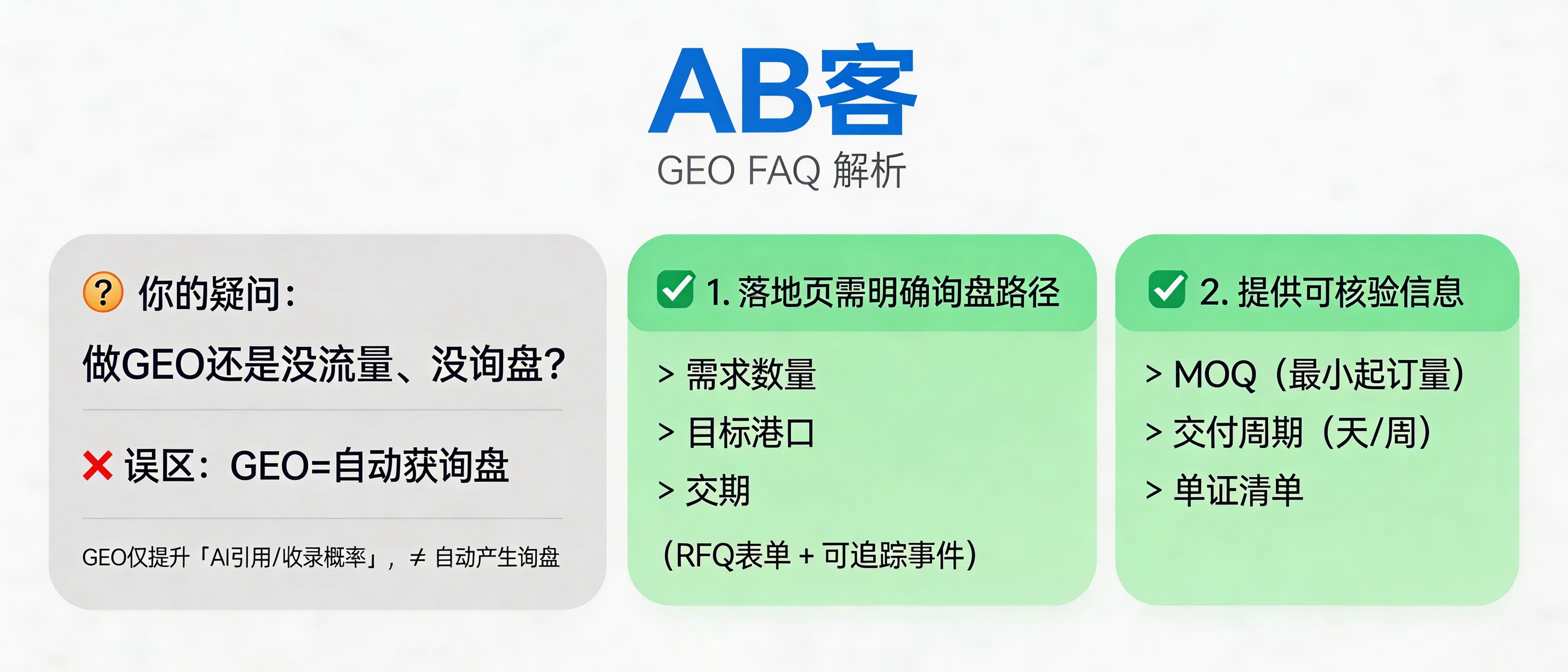
ABKE (AB客) GEO FAQ: Will GEO still result in no traffic or no RFQs?
GEO improves the probability of being cited and included in AI-generated answers (ChatGPT/Perplexity/Gemini), but it does not automatically guarantee inquiries. Learn the minimum conversion requirements: RFQ path, trackable events, and verifiable fields like MOQ, lead time, Incoterms, and documents.

AB Guest FAQ: Why is there no conversion despite having a lot of content? How to supplement purchasing decision information segments for SEO & GEO websites | AB Guest
Content volume ≠ inquiry volume. AB客SEO&GEO websites break down the B2B procurement process into "procurement decision information slices," improving AI referencing and inquiry conversion rates while ensuring that hard information such as parameters, compliance, trade terms, and RFQ fields is complete. At the same time, it clearly identifies inapplicable boundaries such as missing materials and low average order values.

Limited budget: Should I build a showcase site first or an SEO & GEO website? | ABKE GEO FAQ
When budgets are limited but customer acquisition is the goal, showcase websites often focus on brand introductions, lacking indexable long-tail landing pages, GEO structured modules, and conversion paths. ABKe SEO & GEO websites are better suited to first launch the "minimum customer acquisition loop": 1 product + 1 application scenario + 1 conversion path, and gradually expand content and distribution.


.png?x-oss-process=image/resize,h_2000,m_lfit/format,webp)






了解AB客
专业顾问实时为您提供一对一VIP服务
.png?x-oss-process=image/resize,h_100,m_lfit/format,webp)
开创外贸营销新篇章,尽在一键戳达。
.png?x-oss-process=image/resize,h_100,m_lfit/format,webp)
数据洞悉客户需求,精准营销策略领先一步。

用智能化解决方案,高效掌握市场动态。
.png?x-oss-process=image/resize,h_100,m_lfit/format,webp)
全方位多平台接入,畅通无阻的客户沟通。
.png?x-oss-process=image/resize,h_100,m_lfit/format,webp)
省时省力,创造高回报,一站搞定国际客户。
.png?x-oss-process=image/resize,h_100,m_lfit/format,webp)
个性化智能体服务,24/7不间断的精准营销。
.png?x-oss-process=image/resize,h_100,m_lfit/format,webp)
多语种内容个性化,跨界营销不是梦。